As I walked out of Hyde Hall, I noticed a tree in the Dry Garden which for most of the year has truly appeared lifeless. Not only have its bare branches come into full leaf, but otherworldly flowers now cover it too.
The leaves really are fantastic - ferny frondy things in lush green, although I gather a 'Summer Chocolate' cultivar has elegant bronze-coloured foliage. The flowers, wispy little pink fluffballs, give the impression that the tree - an albizia - is happily celebrating its apparent return to life.
Albizia julibrissin, "Silk Tree".
(Deciduous tree.)
Planting: Sow seeds in early autumn after collecting them from pods, soaking them in hot water and then leaving them to cool for a day.
Flowering: Late summer.
Aspect: South-facing and sheltered.
Hardiness: Not hardy to freezing point.
Notes:The albizia tree possesses an unusual habit of closing its leaves in rain and overnight. In Persian, it is thus called "night sleeper" (شبخسب or shabkhosb), and in Japanese it is known as nemunoki - "the sleeping tree".
Sunday, 11 September 2016
Saturday, 10 September 2016
A few final glances at Hyde Hall.
As he sets out upon adventure in The Lord of the Rings, Frodo Baggins draws mockery from his dear friends for endlessly looking over his shoulder, sighing and "muttering: 'Shall I ever look down into that valley again, I wonder,' and things like that." As I begin packing, it has occurred to me that there are certain views and delights of Hyde Hall that I have enjoyed a hundred times and shown my family & friends but never described on the blog. A little brief and a little late, but I thought I might make amends for that now.


![]() |
| Amaryllis belladonna (left) and an Albizia tree (above) flower in the Dry Garden, which naturally comes into its own during the burning heat of late summer. |
Farewell to Hyde Hall.
The first time I considered a career in gardening still seems so fresh in my memory, thus I can scarcely believe what I write next. I have finished my apprenticeship, and my time at Hyde Hall is at an end. For two years it has been my centre point, about which so much of my education, my thoughts and conversations have been - and no small measure of hard work. I have become familiar with its gardens and its toolsheds and its routines, and I have grown to care deeply for some of the people there. I'll miss it, and when I imagine new apprentices who'll work on and witness further chapters of Hyde Hall a flicker of envy shall pass across my face. Indeed, I cannot pretend I didn't try to stay a little longer. No one before me has made the leap from apprentice to horticulturist, yet I cannot fault my ambition - and the faces of those who have not appreciated me will serve as a reminder that there are aspects to Hyde Hall I shall not regret leaving behind.
Endings are a time of sadness, but also a time of celebration. If I cannot believe I am leaving Hyde Hall, then words utterly fail to express my astonishment at the news I have passed my RHS Level II Theory exams with commendation. The staggering breadth of knowledge that I needed to retain truly dwarfed anything I battled at degree level, something which many students far more brilliant than myself agreed unanimously. I had to check with at least two sources before I believed the good news, and claim with utmost sincerity that this was a miracle of God.
As for the successful completion of the apprenticeship beyond the classroom - the two years of blood, sweat, and raindrops in the garden - I am rather proud of an engraved trowel from the RHS stating I've made it through. It's not quite a sword to put over the mantelpiece, but a lovely touch.
Somewhere a door is opening. I must lift my head and turn my eyes toward a new horizon. I wonder what it shall bring.
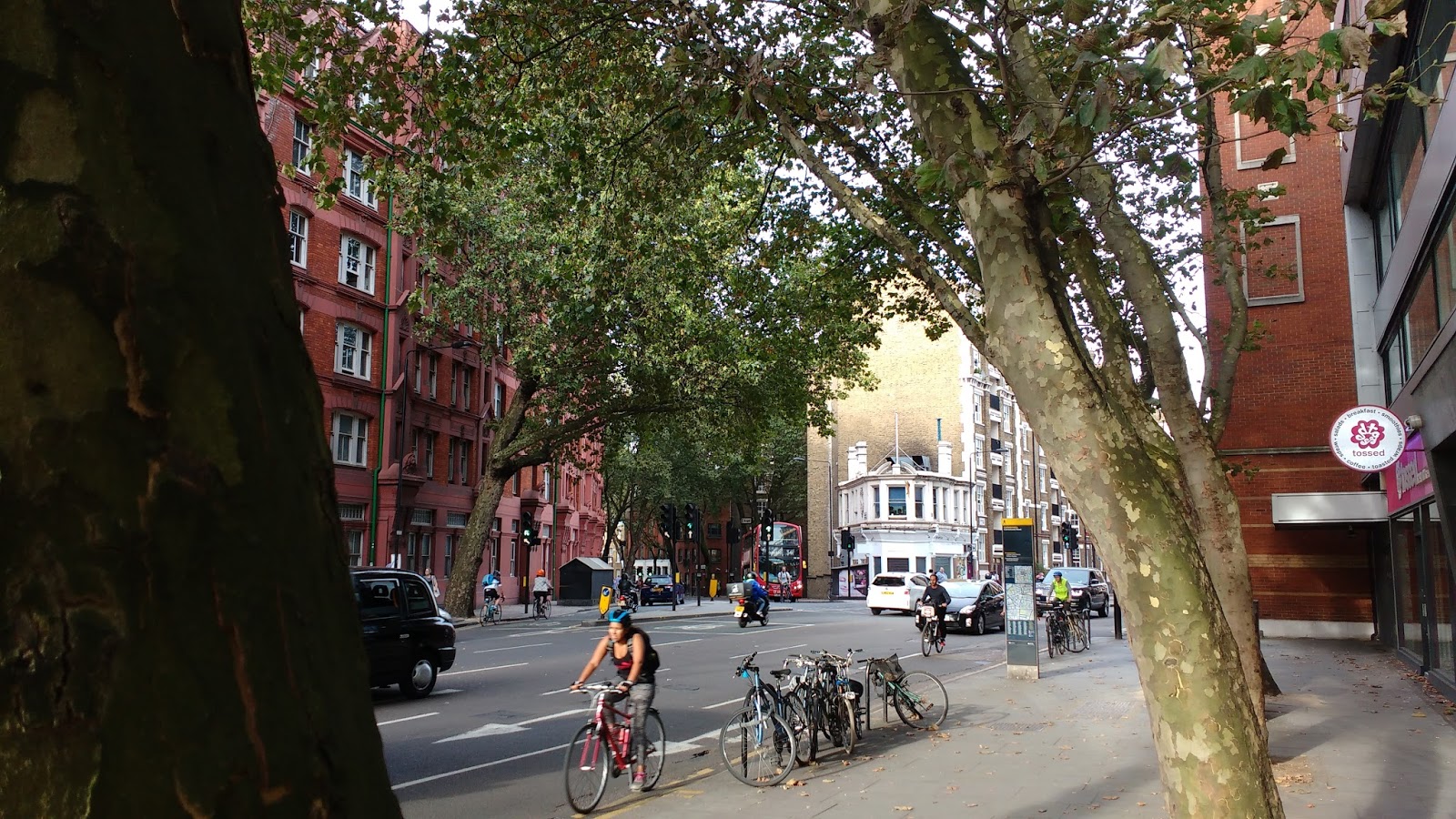
Trees in London.
I'm always thrilled to pass through London - I love the buildings, the parks and the museums, even the underground. Not every day of my life has been a Richard Curtis film but I certainly do experience that feel-good sensation walking through the capital. However, it encourages one of my worst habits: 'people watching'. A perfectly innocent pastime, and an understandable one given the fabulous array of cultures and jobs and individual faces you see there. However, when someone does notice me pondering their business or admiring their hat before I can look away, it does occur to me that my intentions need only be misinterpreted once for a black eye or a police caution. This week I thus resolved to channel my gaze toward another marvel of London.
The city's history of encouraging tree planting and park creation has made for a very leafy present day. In the last minute or so I've learnt that the oldest plane trees here date back to 1789, and I'm very tempted to spend my Saturday looking more deeply into all of this! Indeed there are actually walks designed to take a visitor past some of London's most glorious giants. However, I just thought I would take a few photos of some of the loveliest trees lining my way as I walked from the business district to Euston railway station.
Tuesday, 19 July 2016
Dunham Massey.
In the Hackett family, you have your mug. My Dad has his mug, my Mum has her mug, my sisters have mugs and they don't even drink tea. We probably have hundreds of mugs and many of them are ceramic works of art but nonetheless I use one mug and it is my mug. Family friends Deri & Peter Fabian gave me mine, a little thumbs up before I left Chester. It's emblazoned with 'Head Gardener' - and I hope to keep it until I am indeed the real deal.
If there were ever a way to set the tone of a fairytale garden, outer parkland filled with friendly fallow deer fresh from the forests of Disney does it very nicely. Having made our way through the parkland -- via the ice cream parlour - we entered through some old iron gates.
The gardens offer a generous balance of trees (sometimes specimen trees, but often thickening into woodland), grand shrubs and informal drifts of herbaceous perennials, opening into glades or channels of water. Comparisons could be made to the wild garden at Wisley or the Beth Chatto Gardens, but this feels further along in years. The trees are more mature, creating a sense of a taller and atmospheric garden. Moreover, being a garden from centuries past there are inevitably a few extra curiosities lying in wait for the visitor walking through it. These include moss lawns and a grove of white birches, and to my astonishment a glade of Cardiocrinum giganteum - giant Himalayan lilies. Taking seven years to grow before a sudden eight-foot eruption of white trumpets, they die as soon as they have flowered and set seed. Mastering their cycle to create a display of many flowers in one year is a real feat of horticulture, and a spectacle I shall not forget. Thankfully I had a camera to hand!
The most exciting feature of all, however, was a walled rose garden. White roses, pink roses, red roses, yellow roses, roses lining the paths, roses climbing the walls, rose tunnels, rose pergolas, roses with alliums, roses with lavender, roses with roses. The array of flowers and fragrances, the hum of bees - good golly Miss Molly. It has that magical sweet shop feel about it, and one half expects Willy Wonka to come skipping through the middle. The high old brick walls enclosing the rose garden from the rest of the world enhance the impact it has in many ways, and yet because there are these formal brick walls, and you are surrounded by roses rather than say chocolates, it retains an elegance despite this overwhelming excitement. Because of this, you walk through the garden rather than skipping, and thus you have the chance to savour every scent and every angle. And how many there are to enjoy!
Sadly having to leave the rose garden eventually, and walk back past the Cardiocrinum glade, and then beneath the trees and past the deer herds, my family & I all knew we had just been to somewhere very special indeed. What a fantastic place Peter has worked at. We shall have to return soon - we are certainly not done visiting Dunham Massey.
.
Always an incredibly fit and intelligent man, Peter was hit hard by a stroke recently. He has a strong spirit and Deri is a rock of support, but of course my confidence in his recovery hasn't stopped him being in my prayers. He had mentioned to me that many moons ago he'd worked at a National Trust place called Dunham Massey - it's a funny old name and so it had stayed in the back of my head. This year, the family & I made the time to visit it.
The name Dunham Massey... it certainly sounds very 'National Trust', rather northern - the sort of place to which you'd take an anorak, and which might have an historic mill. No! How poor my imagination. Dunham Massey is a Georgian hall of romantic and heroic history, and has - I'm delighted to say - fabulous gardens. There is a small mill.
If there were ever a way to set the tone of a fairytale garden, outer parkland filled with friendly fallow deer fresh from the forests of Disney does it very nicely. Having made our way through the parkland -- via the ice cream parlour - we entered through some old iron gates.
The gardens offer a generous balance of trees (sometimes specimen trees, but often thickening into woodland), grand shrubs and informal drifts of herbaceous perennials, opening into glades or channels of water. Comparisons could be made to the wild garden at Wisley or the Beth Chatto Gardens, but this feels further along in years. The trees are more mature, creating a sense of a taller and atmospheric garden. Moreover, being a garden from centuries past there are inevitably a few extra curiosities lying in wait for the visitor walking through it. These include moss lawns and a grove of white birches, and to my astonishment a glade of Cardiocrinum giganteum - giant Himalayan lilies. Taking seven years to grow before a sudden eight-foot eruption of white trumpets, they die as soon as they have flowered and set seed. Mastering their cycle to create a display of many flowers in one year is a real feat of horticulture, and a spectacle I shall not forget. Thankfully I had a camera to hand!The most exciting feature of all, however, was a walled rose garden. White roses, pink roses, red roses, yellow roses, roses lining the paths, roses climbing the walls, rose tunnels, rose pergolas, roses with alliums, roses with lavender, roses with roses. The array of flowers and fragrances, the hum of bees - good golly Miss Molly. It has that magical sweet shop feel about it, and one half expects Willy Wonka to come skipping through the middle. The high old brick walls enclosing the rose garden from the rest of the world enhance the impact it has in many ways, and yet because there are these formal brick walls, and you are surrounded by roses rather than say chocolates, it retains an elegance despite this overwhelming excitement. Because of this, you walk through the garden rather than skipping, and thus you have the chance to savour every scent and every angle. And how many there are to enjoy!
Sadly having to leave the rose garden eventually, and walk back past the Cardiocrinum glade, and then beneath the trees and past the deer herds, my family & I all knew we had just been to somewhere very special indeed. What a fantastic place Peter has worked at. We shall have to return soon - we are certainly not done visiting Dunham Massey.
.
Sunday, 17 July 2016
RHS Hampton Court Palace Flower Show.
From the moment I was taught that a person could encourage birds & wild animals by planting a tree or making a pond, I knew that at some point in later life I would seek to create a garden of my own. However, I could never have imagined I would ever play any part in the production of an elite show garden, in the glamorous multi-million world of flower shows. Celebrity guests, cream fedoras and cocktails - even as I've started viewing horticulture as a profession as well as a passion, show gardens have seemed as distant from "real life" as the streets of Hollywood or Bond novels. A bit of fun, far far away.
To my own disbelief, then, I can proudly declare that this summer I was invited to take part in the construction of the Witan Investment Trust Global Growth Garden - not a name which rolls of the tongue, but with a lot of promise as one of the larger show gardens on site. Three of us set off toward Hampton Court Palace to join (first-time) designer Jane Bailey and her landscaping crew for the day: senior horticulturist Matt Oliver (he would return for many of the subsequent days), student Josie Rose, and myself.
Being there during the construction stage was a curious experience, rather like stepping through a looking glass. The noise and busyness of these weeks perfectly equal the show week, yet instead of the hum of a thousand polite conversations in visitors' polished voices, the decibels are made by the raucous yells of landscaping boys, their radios and the reversing beeps of their lorries. In the catering tents, waitresses have to contend with the wolf-whistles of builders and the demands of designers for organic produce - all stood together in the same queue. Obviously the strangest sight of all was of incomplete show-gardens, not yet the immaculate finished articles shown on the nation's televisions. Seeing an actor without their mask or makeup, or a well-loved author's meandering first drafts, must produce a similar sensation. It was very interesting, very surreal, and shattered a few illusions perhaps - not least that these gardens do not pop out of the ground with some fairy dust and the Ground Force brass band. Yet if this was a chance to step behind the scenes of the circus, I'm delighted to say that the beasts were treated well by the ringmaster - Jane was calm and very friendly, and took the time to explain to us over coffee how she was finding it all from her perspective as a new designer (enjoyable but exhausting hours for many weeks away from home). Normally I'd like to write something on what I liked about the design, which was essentially a beautiful concoction of entirely edible plants, but frankly the focus of the day was to get my head down and get stuck in. Anyway, I'm delighted to say it was awarded a silver gilt medal.
For me, it would be ridiculous to give too much of an opinion on whether or not I'd ever go in for show gardens as part of a future career, having worked just one day. However, I know that I fell in love with horticulture for the long-term good it does, for a beauty which may change seasonally but is never lost, and for homeliness. "Even from the heights of splendour, we bounce back and hurry for the latitudes of home", wrote Annie Dillard. Show gardens may be something I'll steer clear of generally, but I know what a privilege it has been to come along for a day and have even a small part in something so special. I'll never look at them quite the same way again.
The first published piece!
In the same way that every family & home sees good times
and bad times, so too does every garden. In recent years many gardens have had to
prune back staff numbers to balance their books, and thus the initiative of the
RHS to create opportunities with apprenticeships and studentships is to be really
celebrated. I’ve been invited to speak on several occasions about my
apprenticeship, at school outreach events and fundraising evenings. I wondered
whether the RHS would also like me to express my view and appreciation of the
apprenticeship in their monthly publication ‘The Garden’. Of course, being one
of the top twenty-five biggest magazines in the country, to have anything of
mine in its pages would be incredibly exciting - but equally I assumed
something of its stature would not be interested or could use someone better
for the job. What a lovely surprise it was, then, to have an email from
Michelle Housden of the editorial team informing me that they liked the idea! I
think it may have come as a surprise to the team at Hyde Hall too - opening the latest issue over their lunches in the mess room, and seeing
one of their own in the comment section!
"Coming to the completion of my apprenticeship at RHS Garden Hyde Hall, I
know for certain this has been the brightest beginning anyone could ever wish
for.
The intention of the scheme is to gradually immerse apprentices into the
horticultural environment until they can stand on their own two feet as real
gardeners. The first challenge is adjusting to the rhythm and steady pace of
work. The three-hundred-and-sixty acres of Hyde Hall require year-round dedication,
and give ample cause for activity from eight every morning until four every
afternoon, light or dark and rain or shine. It offers an honest picture of
gardening life, not to mention an unrivalled chance to appreciate the true
cycle of a year. There are far more than four seasons here, but endless waves
of colour and interest which individually peak and fade.
Naturally, the next challenge is to familiarise
oneself with the garden’s fantastic array of plants, and the tasks for their
care and maintenance. So much within Hyde Hall’s gardens enthrall, and can
spark an apprentice’s education. Spending a day each week at a local college
also upholds one’s focus, especially with the occasional exam thrown in. However,
as with any apprenticeship much also depends on the character of the
experienced professional. Their ability to inspire and to lead is essential.
Although each horticulturalist at Hyde Hall has a a different personality and a
different part of the gardens to call their own, they all show such patience and
take time everyday to explain what is happening in their area. I’ve never had a
question ignored or unanswered, and the horticulturalists invariably work twice
as hard as the students around them. It means I understand what I need to do
each day, and feel a drive to support the garden and the team by working as
hard as I can.
Although the success of
the apprenticeship can be measured by exams passed and years completed, leaps
in confidence and opportunities to actually teach others have been the real
milestones for me. I explained annuals, biennials and perennials to a new
college student last week, and my mother now prunes out dead, damaged and
diseased stems from her roses following her son’s first ever tutorial. Of course,
there are still countless things I’m yet to learn which lie ahead - but what a
brilliant, welcoming first step into horticulture the RHS apprenticeship has
been."
Thursday, 14 July 2016
Michelle Hand, my fiancée.
On a cold grey day several years ago, I was sat in a café with my vicar, the Reverend Graham Shaw. A relatively young man himself, Graham was a little further along the road and far wiser than me - in the perfect position to offer a little life advice over some tea and bacon. The topic of conversation had reached love, whether I was truly happy with what I had at the time, and where my aspirations for love lay. I wondered if perhaps I hadn't taken a serious view until then, for in my mind's eye I couldn't help but recall the scene introducing the Lady Arwen Undómiel into 'The Lord of the Rings'. In she came, on horseback through a woodland's misty light and a choir's voices rising, her hair flowing and her eyes shining. I'd seen it as a boy, and a decade later it was still all I could picture. Graham knew the scene too. I laughed at my immaturity, my foolishness, and expected him to do the same - an man so knowledgeable and capable, with his intelligent voice and intelligent glasses. He didn't laugh. He smiled, but he didn't laugh. "Actually, Josh - I don't think there's anything foolish about wanting something like that." I remember him saying that now as vividly as the scene itself.Last March, walking toward me in the very church of the same reverend came Michelle Hand. Over a year she has revealed herself to be the loveliest person I have ever met or ever shall meet, in beauty and in kindness. She endlessly listens and thinks, cares and prays. Whether it is this, or perhaps her long billowing hair and her soft Northern Irish voice, I have been completely enchanted. Tree or flower, I believe that were there a plant in my garden which had her virtues everyone would come from every corner of the world to admire it. Indeed it has been a pleasure to tell her about everything which I had learned in the last three years about gardening, and look forward to sharing all my future horticultural adventures with the finest companion. In return, perhaps this blog shall stray in future from flora into fauna as her passion lies in horses.
The proposal came on Friday the 17th June, the night before Michelle flew for an internship at Virginia Tech - a little of "now or never" about the occasion. Of course, plants were never far away from proceedings. The ring came from wonderful Scottish ringmaker Sarah Brown, unique with "seaforest" details of leaves and berries in the goldwork around the diamonds. As for the setting, it had to be the garden. Doing my best to distract Michelle whilst the evening set in and darkness fell, my mother and sisters silently ran out and lit a trail of lamps and lanterns through the garden leading down to my old pond at the bottom, which they filled with floating candles and surrounded with more lights. Once everything was alight, Mum gave the signal - calling to innocently ask whether Michelle would like me to show her a new iris in flower down by the pond. Michelle said yes, she would - and ten minutes later, she said yes again to a very different question indeed.
She truly is the loveliest blessing in my life, and I thank God that the adventure I initially started writing about shall now be a journey for two, and all the richer for it.
Sunday, 10 April 2016
Spirit, Dan Pearson.
Merely two years ago, I had no idea who Dan Pearson was nor had I really heard his name. Of course my ignorance has now passed - one would have to try rather hard not to come upon the most respected of garden designers and indeed he reigned champion at the first RHS Chelsea Flower Show I'd visited, his Chatsworth design winning Best Show Garden.
The first book given to me once I had set my heart upon horticulture was his, Spirit. (Delightfully, I've been given many - Mum gave me this one.) It's a fabulous book, filled with memories and adventures and chance meetings. His photographs are so captivating, whether it is they which accompany the text or if it is the text which accompanies them is a distinction left blurred. Each source of interest and influence is touched upon, as boy, student, and man, and the reader is taken from the barge gardens of London to the palatial fountains of the Alhambra. The more one studies this scrapbook of inspiration (there has to be a better word than scrapbook but it escapes me), the deeper one can peek into Dan Pearson's soul. Perhaps because of this, the garden he created at Chelsea did feel familiar - as though seeing a final tapestry, having looked at the threads before it was made. No hierarchy of importance is suggested between the chapters, presumably all influences have touched him at different times or in different ways. However, not being Dan Pearson I definitely have preferred sections. I've read a couple of them to Michelle and thought I'd write down a few quotes here so that I don't forget them.

"Trees have been kept multi-stemmed in the garden so that they feel wild, and minimising the use of colour has kept the garden feeling pure."
(Violante Visconte, the late owner: "Daniel! This is southern Italy, I want everything to be green. There will be no silver, no colour other than green and white. I want cool colours.")

"Inky bay is used to make the connection to the evergreen oaks beyond the walls and to create dark pools for the bright light to be absorbed into. Magnolias and handkerchief trees throw pools of light into the garden as contrast."
"The plants are massed so that the pacing revolves around a series of events. A ravine of scented crab apples, incandescent with blossom in April, the floor a carpet of violets and hung with fruit in autumn. The garden erupts and shape-shifts between seasons. Blues are allowed to hover in shade like anemone in the woods, flowers are kept simple and single and as close to type as possible. The purity is crucial as a counterpoint to the slightly melancholy mood. These interludes in the seasonality of the garden are intended to be sensual and all consuming and you are encouraged to be lost there for the time they hold your attention. The combination of light and flower or scent or moisture in the air are something that can never be repeated, for each is specific to the way that the components come together at that particular point. It is the garden that puts you in the moment and you savour the brevity in the knowledge that it will never be repeated in quite the same way again.
Those gardens that use nature for their romantic gain, but strike that delicate balance between it being invited in and not quite having the upper hand are always in balance. It is in this balance that I find the most evocative moments, the points where the magic occurs. I suspect that the ephemeral nature of these interludes is the greater part of their appeal, and for me, trying to capture them is part of the art of garden making."
Japanese Gardens
"I was taken behind the scenes and allowed to see the gardens at dawn and dusk, when they are at their most peaceful and the light is at its best."
"The introduction to the way of being in the garden was aided by a ritual that you have to go through before you are allowed to enter. We had to sit on the floor in the temple and those who could chanted with the monks, those who could not traced over a prayer with pen and ink. It was only after you have completed the task that you are allowed to enter the garden, and by this time you have been put into quite another frame of mind by being part of the ritual."
"Mr Kubo [designer of Kengo In] recognised the importance of informality, how nature rarely drew a straight line and how the eye preferred asymmetry."
"The approach to the temple is up a wide set of steps that were timeworn and imperfect, overhung with maples and encrusted with moss. Imperfection is important in its place, and age and patina are revered."
"You are invited to move around and through the garden on a series of tiny paths and stepping stones that are configured to slow your movement. By being forced to concentrate on footfall, you are encouraged to take in your surroundings with a new intensity... you might notice that a single camellia flower, crimson against the green of a fallen leaf is left there as contrast. With such evident attention to detail, I was not surprised to discover that it can take up to twenty-five years to qualify as a Japanese gardener."
"[Visiting the garden] You have been part of a journey and consumed in the moment and your senses have been teased very gently so that your antennae are newly receptive to the subtleties of the natural world."
The first book given to me once I had set my heart upon horticulture was his, Spirit. (Delightfully, I've been given many - Mum gave me this one.) It's a fabulous book, filled with memories and adventures and chance meetings. His photographs are so captivating, whether it is they which accompany the text or if it is the text which accompanies them is a distinction left blurred. Each source of interest and influence is touched upon, as boy, student, and man, and the reader is taken from the barge gardens of London to the palatial fountains of the Alhambra. The more one studies this scrapbook of inspiration (there has to be a better word than scrapbook but it escapes me), the deeper one can peek into Dan Pearson's soul. Perhaps because of this, the garden he created at Chelsea did feel familiar - as though seeing a final tapestry, having looked at the threads before it was made. No hierarchy of importance is suggested between the chapters, presumably all influences have touched him at different times or in different ways. However, not being Dan Pearson I definitely have preferred sections. I've read a couple of them to Michelle and thought I'd write down a few quotes here so that I don't forget them.

"Trees have been kept multi-stemmed in the garden so that they feel wild, and minimising the use of colour has kept the garden feeling pure."
(Violante Visconte, the late owner: "Daniel! This is southern Italy, I want everything to be green. There will be no silver, no colour other than green and white. I want cool colours.")

"Inky bay is used to make the connection to the evergreen oaks beyond the walls and to create dark pools for the bright light to be absorbed into. Magnolias and handkerchief trees throw pools of light into the garden as contrast."
"The plants are massed so that the pacing revolves around a series of events. A ravine of scented crab apples, incandescent with blossom in April, the floor a carpet of violets and hung with fruit in autumn. The garden erupts and shape-shifts between seasons. Blues are allowed to hover in shade like anemone in the woods, flowers are kept simple and single and as close to type as possible. The purity is crucial as a counterpoint to the slightly melancholy mood. These interludes in the seasonality of the garden are intended to be sensual and all consuming and you are encouraged to be lost there for the time they hold your attention. The combination of light and flower or scent or moisture in the air are something that can never be repeated, for each is specific to the way that the components come together at that particular point. It is the garden that puts you in the moment and you savour the brevity in the knowledge that it will never be repeated in quite the same way again.
Those gardens that use nature for their romantic gain, but strike that delicate balance between it being invited in and not quite having the upper hand are always in balance. It is in this balance that I find the most evocative moments, the points where the magic occurs. I suspect that the ephemeral nature of these interludes is the greater part of their appeal, and for me, trying to capture them is part of the art of garden making."
Japanese Gardens
"I was taken behind the scenes and allowed to see the gardens at dawn and dusk, when they are at their most peaceful and the light is at its best."
"The introduction to the way of being in the garden was aided by a ritual that you have to go through before you are allowed to enter. We had to sit on the floor in the temple and those who could chanted with the monks, those who could not traced over a prayer with pen and ink. It was only after you have completed the task that you are allowed to enter the garden, and by this time you have been put into quite another frame of mind by being part of the ritual."
"Mr Kubo [designer of Kengo In] recognised the importance of informality, how nature rarely drew a straight line and how the eye preferred asymmetry."
"The approach to the temple is up a wide set of steps that were timeworn and imperfect, overhung with maples and encrusted with moss. Imperfection is important in its place, and age and patina are revered."
"You are invited to move around and through the garden on a series of tiny paths and stepping stones that are configured to slow your movement. By being forced to concentrate on footfall, you are encouraged to take in your surroundings with a new intensity... you might notice that a single camellia flower, crimson against the green of a fallen leaf is left there as contrast. With such evident attention to detail, I was not surprised to discover that it can take up to twenty-five years to qualify as a Japanese gardener."
"[Visiting the garden] You have been part of a journey and consumed in the moment and your senses have been teased very gently so that your antennae are newly receptive to the subtleties of the natural world."
Wednesday, 9 March 2016
A Garden for the Church.
Hyde Hall is such a vibrant garden, with a real sense of momentum and expectation. The apprentices here and now are watching a garden evolve and expand. For me personally, this has been backlit beautifully with an introduction to the rolling hills and woods of Essex.
For all this excitement, the moment at which I could truly say I felt at home in the curiously-named Essex town of South Woodham Ferrers was once I had stepped inside South Woodham Evangelical Church. (Presumably, South Woodham Ferrers Evangelical Church was just too long a title, and it is considerably easier to say "Swec" as most do, rather than "Swfec".) The welcome, kindness and friendship found there has changed things so much for me. It is as though at first I were a plant still potted, enjoying its surroundings but separate from them, and now I have been planted out into the soil here by the church and can now feel part of it all. The vicar, Lindsay, the home group which meets every Tuesday evening to talk and support each other, and my two favourites, my extremely special housemates Barbara & June - all are such genuine, lovely people. Furthermore, there are plenty of folk who love to garden and always say hello when they see me at Hyde Hall.
Last autumn, I started to ponder whether there was anything I could do for the church, and make real use of all the things the RHS has taught me. I'd taken a peek into the back garden before - an open space with a well-kept lawn, but perhaps not an illustration of a biblical garden, lush and filled with birdsong, in which once could listen to God. Within a few weeks, a vision came together in my mind's eye, and a plan put on paper. A wildlife garden appears the perfect balance, peaceful but humming with life, attracting young and older visitors to walk down a meandering lawn. Recognisable and well-loved species, large and small, can be planted informally either side with a gentle colour scheme of calming blues & purples, whites and deep greens. The hope is for these plants to grow tall and form a meadow in the dappled shade of a few trees, low in maintenance and a joy to spend time in. Lawn space will be left for the events and celebrations which take place annually in the church, and I've sought to avoid toxic or thorned species so that children can really explore the garden.
Phil and Rose, who care for the "fabric" of the church and have themselves a most charming garden, have been as much a part of the planning process as I have, and Lindsay has been so enthusiastic. A satisfying part of this plan is the funding of the garden. Living with Barbara & June - whom I actually met in church, my rent is low enough for me to fund it myself. I feel a circle has been completed somewhere. In February, after a little presentation the church members decided to give my proposed garden a yes vote... planting begins in April!
For all this excitement, the moment at which I could truly say I felt at home in the curiously-named Essex town of South Woodham Ferrers was once I had stepped inside South Woodham Evangelical Church. (Presumably, South Woodham Ferrers Evangelical Church was just too long a title, and it is considerably easier to say "Swec" as most do, rather than "Swfec".) The welcome, kindness and friendship found there has changed things so much for me. It is as though at first I were a plant still potted, enjoying its surroundings but separate from them, and now I have been planted out into the soil here by the church and can now feel part of it all. The vicar, Lindsay, the home group which meets every Tuesday evening to talk and support each other, and my two favourites, my extremely special housemates Barbara & June - all are such genuine, lovely people. Furthermore, there are plenty of folk who love to garden and always say hello when they see me at Hyde Hall.
Last autumn, I started to ponder whether there was anything I could do for the church, and make real use of all the things the RHS has taught me. I'd taken a peek into the back garden before - an open space with a well-kept lawn, but perhaps not an illustration of a biblical garden, lush and filled with birdsong, in which once could listen to God. Within a few weeks, a vision came together in my mind's eye, and a plan put on paper. A wildlife garden appears the perfect balance, peaceful but humming with life, attracting young and older visitors to walk down a meandering lawn. Recognisable and well-loved species, large and small, can be planted informally either side with a gentle colour scheme of calming blues & purples, whites and deep greens. The hope is for these plants to grow tall and form a meadow in the dappled shade of a few trees, low in maintenance and a joy to spend time in. Lawn space will be left for the events and celebrations which take place annually in the church, and I've sought to avoid toxic or thorned species so that children can really explore the garden.
Phil and Rose, who care for the "fabric" of the church and have themselves a most charming garden, have been as much a part of the planning process as I have, and Lindsay has been so enthusiastic. A satisfying part of this plan is the funding of the garden. Living with Barbara & June - whom I actually met in church, my rent is low enough for me to fund it myself. I feel a circle has been completed somewhere. In February, after a little presentation the church members decided to give my proposed garden a yes vote... planting begins in April!
Subscribe to:
Posts (Atom)