Thursday, 10 November 2016

Belfast Botanic Gardens.

Irish novelist Forrest Reid, Apostate (1926):                 "When I was about six or seven I used to be taken out each morning by my nurse, Emma, to the Botanic Gardens, at that time not yet transformed into a public park. There was a large conservatory there, and the wing of the building where the palms and cactus grew had a glass door bordered with red and yellow panes. On chilly October days I was very fond of flattening my nose against one of these coloured windows, and peering out into an exotic world. What I saw then, in spite of the familiar shape and position of each tree and shrub, was not the Botanic Gardens at all, but a tropical landscape, luxuriant and gorgeous. The damp warmth of the greenhouse atmosphere, the moist earthy smell of the ferns and creepers and mosses growing there, helped to deepen the illusion that I was far away in the virgin forest."

Friday, 28 October 2016

Kells Bay House & Gardens.

                Had we come to the Ring of Kerry to gaze upon the Skellig Isles and nothing else, it would have been a worthy trip. However, Michelle had arranged for us to stay at Kells Bay House & Gardens, known as the 'Jewel of the Ring'. Considering the Ring in question, an unending circle of wonder, one could fairly presume such a bold claim might open the walled garden's gates to disappointment. As grey rainclouds gathered, doubts loomed higher.

                In the end, the clouds could have blackened and the evening drawn in swifter, and still these thoughts would have been dispelled by the enchantment of a garden the like of which I have never seen before nor shall likely see again. What an extraordinary place!
                It began by stepping into the Ladies Walled Garden - perhaps so-named because it is the only part of the gardens with such hallmarks of civilisation as stone paving or roofed benches. Its centre point is a broken tree trunk, thick and ancient-looking, adorned with nature's palette of lichen. Surrounded by trees and shrubs, as we were approaching it in autumn it loomed before us out of a rough circle of red, purple and green foliage - a circle met by further pathways leading higher or lower, past walls or toward mossy stairways and out of sight.
                One path lead out to something signposted the 'Primaeval Forest'. This lay outside of the stone walls, and yet if one were observing from a bird's eye view they could see that, in actuality, this meant stepping into a larger, more ancient and organic "walled" garden. Hills completely surround Kells Bay, each with fabulous names like Cooduff or Teermoyle, and combined with a thick forest canopy overhead they ensure the gardens never fall below five degrees centigrade in temperature. It is because of this natural alignment (and perhaps a little Victorian forestation), in such a remote pocket of Ireland, that something astounding has been borne.
As we discovered on our walk, the sign for a 'Primaeval Forest' did not lead to any old mossy corner but to the largest collection of tree ferns on this northern half of the planet. Brought from thousands of miles away and planted in the nineteenth-century by Mr Rowland Ponsonby Blennerhassett (I've used the words "fabulous names" in this paragraph already - perhaps from now on it worth accepting as an unspoken rule that all Irish names are indeed fabulous), the height, vigour, and sheer numbers of these tender tree ferns left me desperately grasping for a way of communicating to Michelle how horticulturally impressive they were, and of course as I write now it escapes me again. To still exist today, they must have been kept safe from frost for a century. Hundreds of these giants, for a century.

                As I hinted at earlier, part of Kerry's landscape is a result of Victorian forestation - the mass planting of beech, ash, and larch saplings among the preexisting holly and yew. In the present day, these trees are now huge and have produced an understorey of native ferns beneath the canopy, inviting their Antipodean cousins to dwell among them. The greens, golds, and browns of the northern hemisphere blend happily with those of the south, as the tree ferns spread from their initial density into a forest shared with the European trees.


                This forest carries on right down to the sea in one direction, and back up towards the mountains in the other, and the ease with which we were able to quite genuinely lose ourselves in it was remarkable and enjoyable. Perhaps this was due to the endless carpet of beech leaves covering paths - but my suspicion that evening was that beneath the leaves there were no paths to find. Occasionally some roughly hewn steps would come into view, or a short post with an arrow on it, but when they did appear they often seemed to contradict each other. Moreover, the further we walked the narrower the paths became, taking us above and alongside rivers and bogs. One such path had so much water running along its stones, I'm quite sure it had made the transition into a small stream! The sound of running water seen and unseen about our ears made it all the more atmospheric.
A thick old bough falling across a path.
Huge boughs crossed the paths at points, requiring a little athleticism to climb over or under them. Needless to say, this was as far away from the tarmacked wheelchair-friendly layout of the modern public garden as one could imagine. However, were there a visitor unable to scramble or weave along these paths, I wonder if they would even see it changed - for, in its unkempt present state, this is a garden that truly allows you to believe any wild thing might be waiting around the next tree.
It seems that later generations of gardeners have had the same feeling themselves, and now offer a little joke to visitors who feel it too.

                It is an extraordinarily exciting, intimate place, and though I feel deeply inspired by its horticulture and its style, Kells Bay Garden has also immersed me in magic.

Tuesday, 25 October 2016

Valentia Island and the Ring of Kerry.

                In the last post I expressed my joy in coming home. Well, after three months away researching in Virginia my fiancée Michelle has come home herself. The reunion was sweet, and after some time spent in Chester I followed her over the sea to Northern Ireland where her folks live.
                 Understandably things have been rather blissful; it's been lovely seeing all of her family and the horses, enjoying coffees out and happy evenings under the same roof. When Michelle let slip that she'd secretly booked us a trip away to Kells Bay House & Garden in County Kerry, it came as an unexpected cherry on top of a cake already tasty enough! Not that I could turn it down, of course - so off we set, to the sparkling south-western facet of the Emerald Isle.

                County Kerry is considered so beautiful the road circumnavigating most of it has been given the magical title the 'Ring of Kerry'. It certainly lived up to its name! We couldn't visit every treasure there and for the ones we did I couldn't capture their entirety with my camera - though Michelle knows I certainly tried! Before I write about the wonders of Kells Bay Garden, I thought I'd upload photographs from our exploration of Valentia Island and Killarney National Park, as these were created by the hands of God rather than horticulturists!

                The west of Valentia Island looks out into the Atlantic Ocean. Two tiny isles loom out of the misty horizon separating sky from ocean: Little Skellig and Skellig Michael (Sceilig Mhichíl).
Skellig Michael is famous for two separate habitations: a monastery of stone huts built by St Finnian, populated by unimaginably courageous men from the sixth to twelfth century, and jedi knight Luke Skywalker.
The view from Valentia Island: from left to right, Puffin Island, Little Skellig, and Skellig Michael.
The height of the cliffs, the white of the waves, and the strength of the winds are epic, and you truly are witnessing majesty. To attempt sailing out into it all, let alone to live on Skellig Michael, is hard to comprehend and rightly inspires the awe of the modern visitor.


                The next day, we ventured further inland along the Ring of Kerry, passing into Killarney National Park to see Torc Waterfall. It meant leaving behind the bleak coastal terrain and entering deep, deep woods of golden beech.
These trees tower above the road, their high boughs covered with thick green moss and ferns.
The continuous drop of their leaves fills one's vision, but one's hearing is met by the sound of human chatter - the falls and the continuing river attract a steady stream of visitors. Although the voices are an array of different dialects, the language barrier does not prevent offers to take photographs of other parties and consequent expressions of thanks.
With the falls (and our senses) so busy and completely enclosed by forest, it couldn't have been a more different experience to Valentia Island - touching an entirely separate part of the soul. Indeed, having returned to the north we've been asked if we had seen the 'Ladies View', another part of Kerry which is completely different to the islands or the wooded waterfall. I truly believe that one could journey along the Ring every year, and still find fresh landscapes waiting to be discovered and explored.

Saturday, 22 October 2016

Ness Botanic Gardens.

                With my apprenticeship in Essex at an end, the chance to spend time with the family up in Chester is a welcome one. It's also an opportunity to see some of the gardens to be found here in the north west.

                One of the best known is Ness Botanic Gardens, which lies on the Wirral peninsular between the estuaries of the Mersey and Dee rivers. Other than that - its location - I wasn't sure what to expect. I had visited a couple of years ago, very briefly and at a rather solemn time of year, and as my Grampy would say, "there wasn't much to write home about!" However, the sun was out and three of us (Mum & her friend Sue, both possessing far more horticultural knowledge than I do) set out to see what there was to be seen.

               It didn't take long for me to start questioning whether my last visit had been to a different garden, as the place we entered into this time was filled with colour, interest, and - if I can use a term rarely used in horticultural discussion - genuine coolness.

                Although the longevity of the summer plants at Powis Castle impressed by absolutely denying autumn's arrival, at Ness it was possible to see an intelligent and balanced response to the oncoming season.
                  On the one hand, some of the gardens (much like the RHS gardens, Ness contains an array of themes) remain untempered by seasons due to their style and plant choice. In the rock garden, creeping tufts of shrubs, herbs and grasses sit between crags of (mainly) local sandstone to create a pleasingly naturalistic form.

In the water gardens, the impact of bamboo is immediate - the visitor wants to look at them and through them to the water's surface. Apart from their obvious structural benefit en masse, their stripes add such pizzazz without breaking the green theme. I must jot the species name down next time.

                On the other hand, large parts of the garden have been set to utterly embrace autumn. Of course it is no secret to any gardener that deciduous foliage can transform into attractive colours, but the combinations and concoctions at Ness produce deep, rich tapestries. It truly left me wondering whether those who had chosen the plants could have cared about the other seasons as much, or if such perfect choices for autumn meant horrible clashes in springtime! However, the very fact that the area photographed below is named 'The Azalea Walk' suggests no such sacrifice has been made.

This dawn redwood (Metasequoia glyptostroboides), stood in a less bamboo-ey corner of the water gardens, may still be bright green but will look extraordinary once its foliage turns to a fiery orange.

Moreover, as with any garden that contains the katsura tree (Cercidiphyllum japonicum), attention has clearly been given to autumnal scents as well as to sights.

It may not relate to my enjoyment of the garden's autumnal treats, but I must mention one other aspect of Ness: labelling. One only has to look at the titles of the katsura and dawn redwood trees mentioned above in italics to suspect that I did not venture into horticulture out of love for botanical latin names. They are hard to spell, and harder still to pronounce. However, it is far more of a headache to walk away from a beautiful plant without knowing its name whatsoever, rendering the chances of finding another for one's own garden an impossibility. With this in mind, I must offer the gardeners at Ness my highest praise, for the most thorough labelling effort in any garden I have come upon. Not only is it something tremendously helpful in practical terms (and I do strive to do the same in whichever garden I come to work in), but it also generates a friendliness about the place. It is very much appreciated, and one of many reasons why I am glad to be home.

Monday, 26 September 2016

Powis Castle.

          I'm still very much a boy at heart, and I don't think I'm alone in saying that a good castle sets my pulse racing. What constitutes a "good" castle? Well, a good castle and castle garden should have fresh excitement awaiting on every level, from bottom to top.
Constructed in an ancient Welsh kingdom and embellished with every passing century, Powis Castle is a very good castle indeed - and its garden of many tiers revealed countless reasons for excitement on a grey September afternoon.

          Unless you are a medieval warrior assaulting the ramparts, a visit to the castle garden starts at the top.
Walking beneath wisteria-festooned gateways and between wandering peacocks (no less), you come into a central courtyard with a long stone balustrade along its eastern side. Its height has been cannily calculated - short in appearance, but just managing to screen the view beyond, compelling you to walk across and lean over it like a ship's rail.
It works beautifully - not only does the Severn Valley lie before you, but so too does a second teaser, as glimpses of the gardens below can be seen behind yew trees and hedge-lines.

                Once you have descended past the courtyard, these yews are as much a part of the castle's structure, majesty and eccentricity as the stonework - some sitting like giant bearskin hats, and others forming entire walls. One hedge is a truly colossal fourteen metres in height, and some yews date back to the 1680s which makes them older than some countries. Initially abstract in shape, the hedges straighten further down the garden (some are yew, others are crisp box hedges), and the va va voom factor moves from the hedges into what the hedges are containing: herbaceous borders.

                I'm not familiar with the climate of the Severn Valley, but clearly some magic occurs here. With the summer seemingly behind us, the gardeners here had clearly kept it a secret from the dahlias, pelargoniums, rudbeckias and ricinus plants which all stood as tall and bright as though it were a sunny day in late June - looking all the prouder for not caring that it wasn't. Whatever the trick is, it has seemingly been steadily honed over a great length of time: old photographs placed at particularly scenic points in the garden show moustached gardeners stood before the very same flowerbeds, virtually identical in appearance.
                As the garden finally descends to its lowest point the pathways are replaced by wide lawns, and the plants of these borders tumble across them - traditional, romantic choices such as hollyhocks and Japanese anemones in pinks and pale yellows. To reach these pretty squares, however, one must pass through one of the most enjoyable parts of the garden. The moustached gardeners clearly had flair for fruit-growing, creating two avenues of apple and pear trees. Their rounded forms would be charming enough, with every lichen-encrusted branch curling at its tip and revealing decades of loving pruning. However each tree is also underplanted with circles of herbs which adds further interest, splashes of colour right along the path and something marvellous which I have never seen before.

                A gentle fountain marks the end of the formal horticulture, but not the end of the garden. Ascending from the lawns into wilder banks of mature trees and shrubs, and the season's first sprays of cyclamen flowers, the pathway finishes upon a large pond. Walking along this winding stretch, the view of the castle and its many terraces (another visitor has titled it Wales' very own Hanging Gardens) naturally draws the eyes back westwards. It is, then, all too easy to pass by the quiet corner on the other side of the path which holds my favourite part of the garden: the plunge pool.

                A small sign adjacent to the pool explains that eighteenth century thinking upheld bathing as beneficial to one's health, and a bath placed out in the fresh air with beautiful views as beneficial to one's soul. Stood in the shade of the rhododendrons and charmed by the old stonework covered in moss and hart's tongue ferns, I felt it unnecessary of the sign's writer to limit the description of an obvious truth to a mere philosophy (and an apparently dated one at that)!
                Baths are one of my deepest pleasures, and the regularity with which I can be found in one has caused plentiful amusement amongst my friends. They shall certainly be my secret weapon against back and knee weariness as I continue gardening. I cannot enthuse strongly enough how much I desire to replicate this beautiful pool in my own garden one day. It marks the last in a fabulous array of wonders found at Powis Castle, a bastion of colour and vitality against the grey September skies. It does, quite naturally, raise the question as to what else can be found here in spring and summer!
I very much intend to return and to find the answer.


Sunday, 11 September 2016

Albizia julibrissin.

As I walked out of Hyde Hall, I noticed a tree in the Dry Garden which for most of the year has truly appeared lifeless. Not only have its bare branches come into full leaf, but otherworldly flowers now cover it too.
       The leaves really are fantastic - ferny frondy things in lush green, although I gather a 'Summer Chocolate' cultivar has elegant bronze-coloured foliage. The flowers, wispy little pink fluffballs, give the impression that the tree - an albizia - is happily celebrating its apparent return to life.


Albizia julibrissin, "Silk Tree".
(Deciduous tree.)


Planting: Sow seeds in early autumn after collecting them from pods, soaking them in hot water and then leaving them to cool for a day.
Flowering: Late summer.
Aspect: South-facing and sheltered.
Hardiness: Not hardy to freezing point.


Notes:The albizia tree possesses an unusual habit of closing its leaves in rain and overnight. In Persian, it is thus called "night sleeper" (شب‌خسب or shabkhosb), and in Japanese it is known as nemunoki - "the sleeping tree".

Saturday, 10 September 2016

A few final glances at Hyde Hall.

As he sets out upon adventure in The Lord of the Rings, Frodo Baggins draws mockery from his dear friends for endlessly looking over his shoulder, sighing and "muttering: 'Shall I ever look down into that valley again, I wonder,' and things like that." As I begin packing, it has occurred to me that there are certain views and delights of Hyde Hall that I have enjoyed a hundred times and shown my family & friends but never described on the blog. A little brief and a little late, but I thought I might make amends for that now.

Andy T's Aussie Border (or less informally, the Australia & New Zealand Garden created by Andy Tebbutt).
Anemanthele grass, white libertia, glorious eucalyptus trees - and best of all, tall blue-flowered Solanum laciniatum which appeared as weeds but being Australian were hastily added to the party's guestlist.


Amaryllis belladonna (left) and an Albizia tree (above) flower in the Dry Garden,
which naturally comes into its own during the burning heat of late summer.

Farewell to Hyde Hall.


                The first time I considered a career in gardening still seems so fresh in my memory, thus I can scarcely believe what I write next. I have finished my apprenticeship, and my time at Hyde Hall is at an end. For two years it has been my centre point, about which so much of my education, my thoughts and conversations have been - and no small measure of hard work. I have become familiar with its gardens and its toolsheds and its routines, and I have grown to care deeply for some of the people there. I'll miss it, and when I imagine new apprentices who'll work on and witness further chapters of Hyde Hall a flicker of envy shall pass across my face. Indeed, I cannot pretend I didn't try to stay a little longer. No one before me has made the leap from apprentice to horticulturist, yet I cannot fault my ambition - and the faces of those who have not appreciated me will serve as a reminder that there are aspects to Hyde Hall I shall not regret leaving behind.

                Endings are a time of sadness, but also a time of celebration. If I cannot believe I am leaving Hyde Hall, then words utterly fail to express my astonishment at the news I have passed my RHS Level II Theory exams with commendation. The staggering breadth of knowledge that I needed to retain truly dwarfed anything I battled at degree level, something which many students far more brilliant than myself agreed unanimously. I had to check with at least two sources before I believed the good news, and claim with utmost sincerity that this was a miracle of God.
As for the successful completion of the apprenticeship beyond the classroom - the two years of blood, sweat, and raindrops in the garden - I am rather proud of an engraved trowel from the RHS stating I've made it through. It's not quite a sword to put over the mantelpiece, but a lovely touch.


Somewhere a door is opening. I must lift my head and turn my eyes toward a new horizon. I wonder what it shall bring.


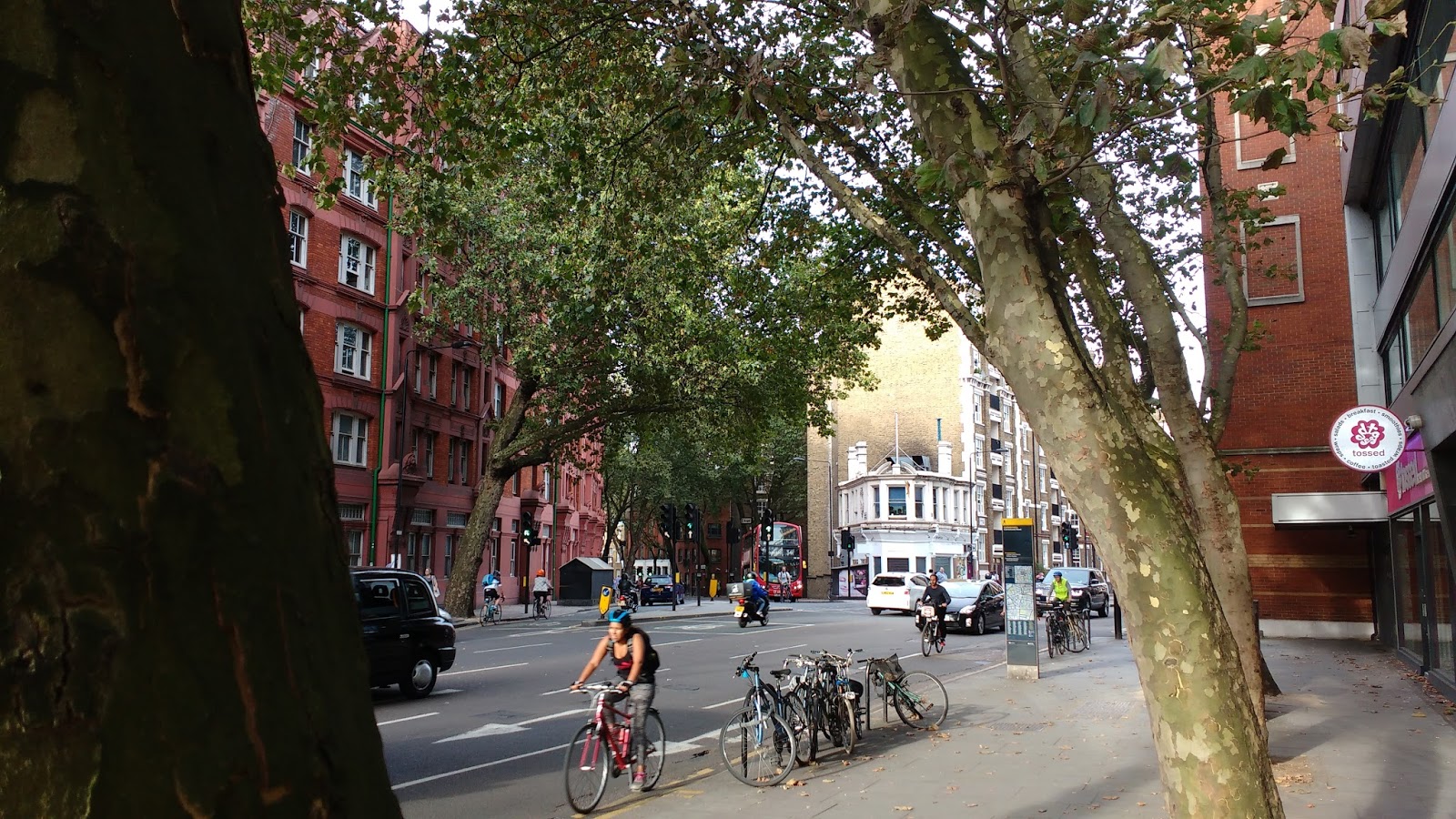
Trees in London.

I'm always thrilled to pass through London - I love the buildings, the parks and the museums, even the underground. Not every day of my life has been a Richard Curtis film but I certainly do experience that feel-good sensation walking through the capital. However, it encourages one of my worst habits: 'people watching'. A perfectly innocent pastime, and an understandable one given the fabulous array of cultures and jobs and individual faces you see there. However, when someone does notice me pondering their business or admiring their hat before I can look away, it does occur to me that my intentions need only be misinterpreted once for a black eye or a police caution. This week I thus resolved to channel my gaze toward another marvel of London.

The city's history of encouraging tree planting and park creation has made for a very leafy present day. In the last minute or so I've learnt that the oldest plane trees here date back to 1789, and I'm very tempted to spend my Saturday looking more deeply into all of this! Indeed there are actually walks designed to take a visitor past some of London's most glorious giants. However, I just thought I would take a few photos of some of the loveliest trees lining my way as I walked from the business district to Euston railway station.


Tuesday, 19 July 2016

Dunham Massey.

          In the Hackett family, you have your mug. My Dad has his mug, my Mum has her mug, my sisters have mugs and they don't even drink tea. We probably have hundreds of mugs and many of them are ceramic works of art but nonetheless I use one mug and it is my mug. Family friends Deri & Peter Fabian gave me mine, a little thumbs up before I left Chester. It's emblazoned with 'Head Gardener' - and I hope to keep it until I am indeed the real deal.
           Always an incredibly fit and intelligent man, Peter was hit hard by a stroke recently. He has a strong spirit and Deri is a rock of support, but of course my confidence in his recovery hasn't stopped him being in my prayers. He had mentioned to me that many moons ago he'd worked at a National Trust place called Dunham Massey - it's a funny old name and so it had stayed in the back of my head. This year, the family & I made the time to visit it.

The name Dunham Massey... it certainly sounds very 'National Trust', rather northern - the sort of place to which you'd take an anorak, and which might have an historic mill. No! How poor my imagination. Dunham Massey is a Georgian hall of romantic and heroic history, and has - I'm delighted to say - fabulous gardens. There is a small mill.
          If there were ever a way to set the tone of a fairytale garden, outer parkland filled with friendly fallow deer fresh from the forests of Disney does it very nicely. Having made our way through the parkland -- via the ice cream parlour - we entered through some old iron gates.
           The gardens offer a generous balance of trees (sometimes specimen trees, but often thickening into woodland), grand shrubs and informal drifts of herbaceous perennials, opening into glades or channels of water. Comparisons could be made to the wild garden at Wisley or the Beth Chatto Gardens, but this feels further along in years. The trees are more mature, creating a sense of a taller and atmospheric garden. Moreover, being a garden from centuries past there are inevitably a few extra curiosities lying in wait for the visitor walking through it. These include moss lawns and a grove of white birches, and to my astonishment a glade of Cardiocrinum giganteum - giant Himalayan lilies. Taking seven years to grow before a sudden eight-foot eruption of white trumpets, they die as soon as they have flowered and set seed. Mastering their cycle to create a display of many flowers in one year is a real feat of horticulture, and a spectacle I shall not forget. Thankfully I had a camera to hand!

          The most exciting feature of all, however, was a walled rose garden. White roses, pink roses, red roses, yellow roses, roses lining the paths, roses climbing the walls, rose tunnels, rose pergolas, roses with alliums, roses with lavender, roses with roses. The array of flowers and fragrances, the hum of bees - good golly Miss Molly. It has that magical sweet shop feel about it, and one half expects Willy Wonka to come skipping through the middle. The high old brick walls enclosing the rose garden from the rest of the world enhance the impact it has in many ways, and yet because there are these formal brick walls, and you are surrounded by roses rather than say chocolates, it retains an elegance despite this overwhelming excitement. Because of this, you walk through the garden rather than skipping, and thus you have the chance to savour every scent and every angle. And how many there are to enjoy!
          Sadly having to leave the rose garden eventually, and walk back past the Cardiocrinum glade, and then beneath the trees and past the deer herds, my family & I all knew we had just been to somewhere very special indeed. What a fantastic place Peter has worked at. We shall have to return soon - we are certainly not done visiting Dunham Massey.

.